Sign In | Join Free | My burrillandco.com
Home > Rechargeable Lifepo4 Battery >

20Ah 3.2V Rechargeable LiFePO4 Battery Pack High Rate UL UN38.3 IEC62619 Approval

    Buy cheap 20Ah 3.2V Rechargeable LiFePO4 Battery Pack High Rate UL UN38.3 IEC62619 Approval from wholesalers
     
    Buy cheap 20Ah 3.2V Rechargeable LiFePO4 Battery Pack High Rate UL UN38.3 IEC62619 Approval from wholesalers
    • Buy cheap 20Ah 3.2V Rechargeable LiFePO4 Battery Pack High Rate UL UN38.3 IEC62619 Approval from wholesalers
    • Buy cheap 20Ah 3.2V Rechargeable LiFePO4 Battery Pack High Rate UL UN38.3 IEC62619 Approval from wholesalers
    • Buy cheap 20Ah 3.2V Rechargeable LiFePO4 Battery Pack High Rate UL UN38.3 IEC62619 Approval from wholesalers

    20Ah 3.2V Rechargeable LiFePO4 Battery Pack High Rate UL UN38.3 IEC62619 Approval

    Ask Lasest Price
    Brand Name : Topband
    Model Number : TB-027070169H-Fe-20Ah
    Certification : CE,UL,UN38.3,MSDS
    Price : Negotiable
    Payment Terms : T/T, L/C
    Supply Ability : 450Mwh/year
    Delivery Time : 2~4weeks for samples; 4~6weeks for mass production
    • Product Details
    • Company Profile

    20Ah 3.2V Rechargeable LiFePO4 Battery Pack High Rate UL UN38.3 IEC62619 Approval

    3.2V 20Ah Rechargeable LiFePO4 Battery Pack High Rate UL UN38.3 IEC62619 Approval


    1,General

    This product specification describes the technique standards, test methods and precaution notes of prismatic type Lithium iron phosphate rechargeable cell, manufactured by Shenzhen Topband New Energy Technology CO.,LTD.


    2,Product specification

    No.itemstandardremark

    2.1


    Nominal Capacity


    20Ah


    25±5℃,1C discharge

    2.2Min capacity19.5Ah
    2.3Internal Impedance≤2mΩ
    2.4Nominal Voltage3.2V
    2.5Weight610±20g

    2.6


    Max charge Voltage


    3.65V


    At CC mode

    2.7


    End-of-charge Current


    0.05C


    At CV mode

    2.8


    Cut-off discharge Voltage


    2.00V

    2.9


    Standard Charge Method


    1C CC/CV

    25±5℃

    2.10


    Max Continuous Discharge current


    10C


    Discharge Time: 6minutes

    2.11


    Max pulse Discharge Current


    14C


    Discharge Time: 10 seconds


    2.12


    Cycle Life


    2500cycles

    At room temperature 25℃;

    1C Continuous Discharge and 1C continouse charge current; ≥80% SOC (100% DOD)

    25±5℃

    2.13


    Calendar Life


    5 years

    2.14


    Charging Temperature

    0~45℃

    2.15


    Discharging Temperature


    -20~55℃

    2.16


    Storage Temperature

    -10~30℃

    2.17


    Apprearance

    Without break, scratch, distortion, contamination, leakage and so on

    3,Test Conditions


    3.1 Standard Test Conditions

    3.1 All tests stated in this Product Specification are conducted at temperature 25℃±5℃ and humidity 15℅~90% RH, atmospheric pressure 86kPa~106kPa.

    3.2 Standard Charge Method

    The "Standard Charge" means in an ambient temperature of 25℃±5℃, the cell was discharged with 1C constant discharge current to cut-off voltage 2.0 V, standing 1h. Then charged it with

    1C constant current to 3.65V, then charge mode turn into CV mode, until the charging current is down to 0.05C, then end of charging and standing 1h.


    4,Electrical Characteristics


    itemTest methodCriteria

    4.1 High Temperature

    Discharge Performance


    The cell was charged in accordance with 3.2, and stored in an ambient temperature of 55℃±3℃ for 5h, then discharged to cut-off voltage with a constant current of 1C. After that, fetch out the cell and place it in the ambient temperature of 25℃±5℃ for 4h then check its appearance.


    Capacity retention at 55℃

    :≥95%


    4.2 Low Temperature Discharge Performance


    The cell was charged in accordance with 3.2, and stored in an ambient temperature of -20℃±3℃ for 24 hours, then

    discharged to cut-off voltage 2.0V at a constant current of 1C. After that, fetch out the cell and place it in the ambient

    temperature of 25℃±5℃ for 4hours, then check its

    appearance.


    Capacity retention at -20℃

    :≥80%


    4.3 Rate Charge Performance

    in Normal Temperature

    Under the ambient temperature of 25℃±5℃

    1. Discharged the cell with 1C constant current until the cut off voltage to 2.0V, stay for 1h.
    2. Charged the cells with 5C constant current until the voltage to 3.65V, stay for 1h.
    3. Discharged the cells with constant current until the cut off voltage 2.0V.

    5C charge capacity≥80%


    4.4 Rate Discharge Performance in Normal Temperature


    The cell was charged in accordance with 3.2, then discharge to cut-off voltage 2.0V with 10C current in an ambient

    temperature of 25℃±5℃.


    10C discharge capacity≥95%


    4.5 Cycle Life

    (25℃±5℃)

    The cell was fully charged to 3.65V with 1C (cc/cv), after that stayed for 30min; Subsequently, the cell was discharged to cut-off voltage 2.0V with constant current 1C, and stayed 30 minites; prior to next charge-discharge cycle. Record all the

    cycles until the retention capacity<80%.


    ≥2500cycles


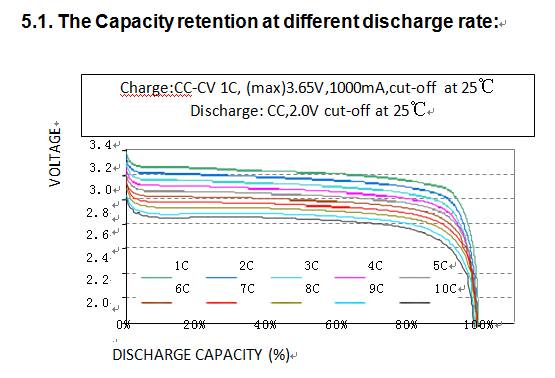
    5. The performance test curve (for reference):


    5.2 The Capacity retention at different discharge rate:


    6,Environmental Characteristics

    No

    .


    Item


    Test Method


    Criteria

    6.1

    Temperature shock test

    A cell is charged in accordance with 3.2, and then repeat the following procedures for 5 cycles, then check the cell's appearance.20Ah 3.2V Rechargeable LiFePO4 Battery Pack High Rate UL UN38.3 IEC62619 Approval

    No leakage, no fire, no explosion, no vent

    6.2

    Low-pressure Test

    The cell is charged in accordance with 3.2, then stored for 6h at a vacuum of -90KPa, after that put the cell in room temperature for 6h, then check the cell's appearance.

    No leakage, no fire, no explosion, no vent

    6.3

    Vibration Test

    The cell is charged in accordance with 3.2, and then installed onto the vibration machine. Equipment parameters of frequency and amplitude are set as bellow (the frequency is to be varied at the rate of 1oct/min between 10 and 55 Hz, and repeat vibration for 30 min. The cell is tested in three mutually perpendicular directions, i.e. X,Y,Z):

    1. frequency:10Hz~30Hz, amplitude: 0.38mm;
    2. frequency:30Hz~55Hz amplitude: 0.19mm

    No scratch, no fire, no explosion, no vent;


    The voltage is

    not less than 3.2V.

    6.4

    Shock Test

    The cell is tested in accordance with 3.2, and then secured to the testing machine by means of rigid mount which supports all mounting surfaces of the cell. Each cell shall be subjected to a total of three shocks of equal magnitude. The shocks are to be applied in each of three mutually perpendicular directions. The acceleration and impulse time are as follows: acceleration of impulse peak value: 100m/s2, shock frequency:40~80 times/min, impulse lasting time:16 min, shock times:1000±10

    No scratch, no leakage, no fire, no explosion, no vent;


    the voltage is not less than 3.2V.


    7,Safety test

    All below tests are carried out on the equipment with forced ventilation and explosion-proof device. Before test, all cells are charged in accordance with 3.2, and stored 24h prior to test.


    No.ItemTest MethodCriteria

    7.1


    Short- circuit Test

    The cell was charged accordance with 3.2, after that the cell is short-circuited by connecting the positive and negative terminals with a wire for 10min, the wire has a maximum resistance load of 5mΩ., then observe for 1h.

    No fire, no explosion

    7.2

    Overcharge Test

    The cell was tested in accordance with 3.2, then 1C constant current charged till the voltage reaches 1.5 times of the specified end-off charge voltage, or the charge time reaches 1h, then stop charge, and observe for 1h.

    No fire,no explosion

    7.3

    Over discharge test

    The cell was tested in accordance with 3.2, then 1C discharge for 90min, then observe for 1h.

    No fire, no explosion, no leakage

    7.4

    Crush Test

    The cell was tested in accordance with 3.2, and then is placed on the crush machine, the axis is parallel to the crush equiment, and it is crushed between two flat surfaces till the crushing force is gradually approaching 200 kN, or voltage reaches 0V,or reaches 30% distortion, then observe for 1h.

    No fire, no explosion

    7.5

    Impact Test

    The cell was tested in accordance with 3.2, and then placed on the impact flat. A Φ15.8mm bar is to be placed on the center of the cell. A 9.1kg weight is dropped from a height of 610mm onto the cell, the distortion is allowed.

    No fire, no explosion

    7.6

    Stick Test

    1. The cell was tested in accordance with 3.2
    2. use φ5mm~φ8mm high temperature

    resistance steel needle, with speed of

    25±5mm/s, to go through the cell from vertical

    direction of pole plate, the penetrate position

    should be close to the geometric center of plate

    surface, the steel needle remains in the cell;

    No fire, no explosion

    7.7

    Heating Test(130℃)

    The cell was tested in accordance with 3.2, and then heated in a circulating air oven. The temperature of the oven is raised at a rate of

    5℃ per minute to 130℃±3℃ and remain for 30

    min.

    No fire, no explosion


    8,Dimension


    Quality 20Ah 3.2V Rechargeable LiFePO4 Battery Pack High Rate UL UN38.3 IEC62619 Approval for sale
    Inquiry Cart 0
    Send your message to this supplier
     
    *From:
    *To: Shenzhen Topband Battery Co., Ltd
    *Subject:
    *Message:
    Characters Remaining: (0/3000)